
What Is the Most Common Cause of Dental Implant Failure? A Guide to Protecting Your Smile
Jun 15, 2026
Choosing to replace missing teeth with dental implants is one of the best investments you can make for your long-term oral health and self-confidence. Unlike traditional bridges or removable dentures, dental implants look, feel, and function just like your natural teeth. They allow you to eat your favorite foods, speak clearly, and smile without hesitation.
Statistically, dental implants have an incredible success rate, often hovering above 95 percent. However, as with any medical or dental procedure, there is always a small margin for complications. If you are considering this life-changing treatment, or if you already have an implant and want to ensure it lasts a lifetime, you might wonder about the risks. Specifically, what is the most common cause of dental implant failure?
It is completely normal to feel a bit anxious about the possibility of a procedure failing, especially when you are investing your time and hard-earned money into your smile. The good news is that most implant failures are entirely preventable. By understanding why failures happen and working closely with a trusted team like Clinton Dental, you can keep your new smile healthy, stable, and beautiful for decades to come.
Early vs. Late Dental Implant Failure
To understand what causes an implant to fail, it helps to look at the timeline. Dental implant failure is generally categorized into two distinct phases: early failure and late failure.
Early Stage Failure (Within the First Few Months)
Early failure occurs within the first few weeks or months following your oral surgery, usually before the permanent replacement tooth, or crown, is attached. During this initial healing phase, the titanium implant post must undergo a natural process called osseointegration. This is where your living jawbone grows tightly around the implant, locking it permanently into place. If your bone fails to fuse properly with the titanium post, the implant will become loose and must be removed. Early failure is often tied to poor bone density, surgical trauma, or an infection that develops immediately after surgery.
Late Stage Failure (Months or Years Later)
Late failure happens long after the implant has successfully fused with your bone and has been actively used for chewing. You could have a perfectly functioning implant for five, ten, or fifteen years before experiencing a problem. When a failure occurs in this later stage, it is almost always caused by environmental factors, lifestyle habits, or bacterial issues rather than a problem with the surgical procedure itself.
The Most Common Cause of Dental Implant Failure: Peri-Implantitis
When looking at long-term statistics, the absolute most common cause of dental implant failure is a specific condition known as peri-implantitis.
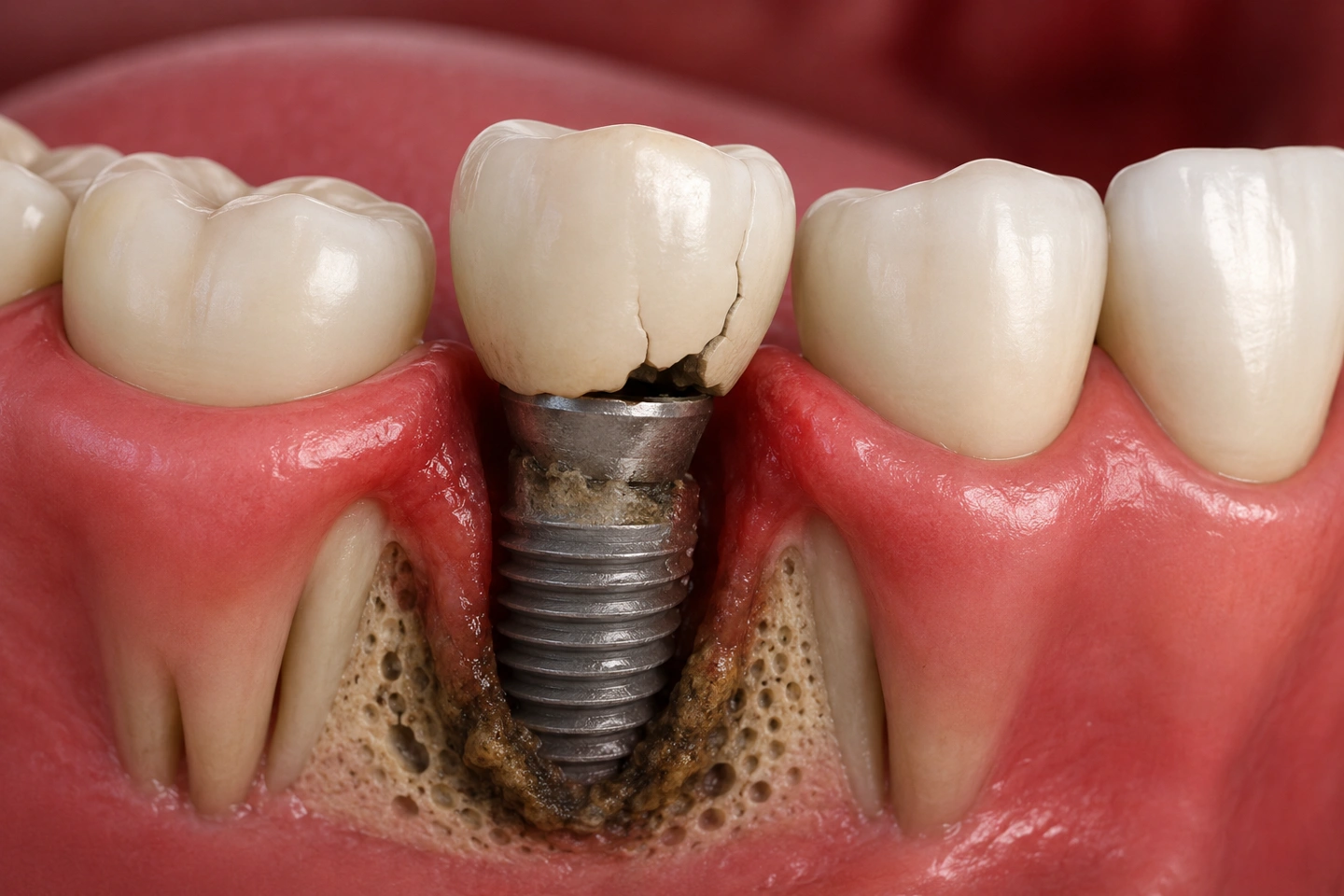
Peri-implantitis is a localized, infectious disease that causes severe inflammation in the gum tissue and bone surrounding a dental implant. To put it simply, it is the implant equivalent of severe periodontal disease, or gum disease.
Just like natural teeth, dental implants are constantly exposed to bacteria, saliva, and food particles. If you do not clean your mouth thoroughly, a sticky film of bacteria called biofilm, or plaque, will begin to accumulate along the gumline of your implant.
Over time, this plaque hardens into a calcified substance called tartar, which cannot be brushed away at home. The bacteria living in this tartar release harmful toxins that irritate your gums. In the early stages, this causes a condition called peri-implant mucositis, which is characterized by red, swollen gums that may bleed when you brush or floss. At this stage, the condition is completely reversible with a professional cleaning and improved oral hygiene.
However, if peri-implant mucositis is left untreated, it progresses into peri-implantitis. The infection moves deeper beneath the gumline, forming deep pockets around the titanium post. The chronic inflammation triggers your body's immune system to mistakenly destroy the very bone cells holding the implant in place. As the bone melts away, the implant loses its structural support, becomes loose, and eventually fails completely.
Other Critical Factors That Can Endanger Your Dental Implants
While peri-implantitis is the leading culprit, several other underlying issues and lifestyle habits can significantly increase your risk of experiencing dental implant failure.
Smoking and Tobacco Use
Smoking is one of the most significant risk factors for both early and late implant failure. Nicotine is a vasoconstrictor, meaning it narrows the blood vessels throughout your body, including the delicate capillaries in your gums. This severely restricts the flow of oxygen, nutrients, and immune cells to the surgical site. Without a healthy blood supply, your jawbone cannot heal or fuse with the implant properly. Furthermore, smoking weakens your body's ability to fight off bacterial infections, making smokers much more vulnerable to developing peri-implantitis.
Insufficient Bone Density
A dental implant requires a strong, thick foundation of jawbone to support it against the massive forces of daily chewing. If you have been missing a tooth for a long time, your jawbone naturally begins to shrink and resorb. If an implant is placed into a jaw with inadequate bone density, the implant will not have enough support to stay stable. This is why the team at Clinton Dental carefully evaluates your bone structure using advanced 3D imaging before surgery, often recommending a routine bone grafting procedure to rebuild the area before the implant is placed.
Uncontrolled Systemic Health Conditions
Your body's overall health directly impacts its ability to heal and maintain bone structure. Systemic conditions like uncontrolled Type 2 diabetes, severe osteoporosis, and autoimmune diseases can significantly interfere with bone healing and osseointegration. For instance, high blood sugar levels impair your immune response and slow down cellular repair, making it much harder for your body to fight off early stage infections around a new implant.
Teeth Grinding and Clenching (Bruxism)
If you chronically grind or clench your teeth at night, a habit known as bruxism, you are placing an immense amount of physical stress on your dental work. While natural teeth are cushioned by a flexible periodontal ligament that absorbs some of this shock, dental implants are fused directly to the bone. Continuous, heavy pressure from grinding can cause micro-fractures in the surrounding bone, loosen the internal screws, or even crack the porcelain crown on top, eventually leading to structural failure.
Simple Steps to Prevent Dental Implant Failure
The thought of an implant failing can be intimidating, but the vast majority of these risks are entirely within your control. By making a few simple adjustments to your daily routine, you can protect your investment and enjoy a healthy smile for a lifetime.
- Commit to Immaculate Oral Hygiene: Treat your dental implants with the same care, or even more care, than your natural teeth. Brush at least twice a day with a soft-bristled toothbrush and use a gentle, low-abrasive toothpaste.
- Floss Daily Without Fail: Standard string floss or specialized implant floss is non-negotiable for cleaning the tight spaces between your crown and the gumline. Many patients find that using a high-quality water flosser is incredibly effective at flushing out trapped food particles and bacteria from beneath the gums.
- Kick the Tobacco Habit: If you currently smoke or use tobacco products, stopping before your implant surgery is the single best thing you can do to ensure a successful outcome and protect your long-term health.
- Wear a Custom Nightguard: If you have a history of grinding your teeth, your dentist can fabricate a comfortable, custom-fitted nightguard. Wearing this protective appliance while you sleep will distribute the pressure evenly and shield your implant from destructive forces.
- Visit Your Dentist Regularly: Skipping your routine dental appointments is a major risk factor for implant issues. Routine exams allow your hygienist to safely remove stubborn tartar and give your dentist a chance to inspect the stability of your implant, catching minor signs of inflammation before they turn into severe bone loss.
Ready to Restore Your Smile Safely? Schedule a Consultation with Clinton Dental
Your smile is an essential part of your identity, your health, and your overall quality of life. If you are living with missing teeth and want to explore the incredible benefits of permanent replacement teeth, or if you have concerns about an existing restoration, you do not have to navigate this journey alone.
At Clinton Dental, we believe that successful implant dentistry combines meticulous clinical skill, state-of-the-art diagnostic technology, and deeply compassionate patient care. Our dedicated team will take the time to evaluate your unique oral health, discuss your lifestyle goals, and create a customized treatment plan designed for maximum safety and long-term success. We are committed to helping you achieve a strong, functional, and radiant smile that you can flash with absolute pride. Contact our office today to schedule your personal consultation and take the first step toward a healthier, more confident future.
Frequently Asked Questions About Dental Implant Failure
Can a failing dental implant be saved?
In many cases, yes, if the problem is caught early enough. If you are diagnosed with early stage peri-implantitis, your dentist can perform targeted treatments like deep bacterial cleanings, laser therapy to sterilize the area, or prescription antibiotic rinses. If significant bone loss has occurred, advanced bone grafting procedures can sometimes be used to rebuild the lost foundation and restabilize the post. However, if the implant is completely loose, it must be removed.
What does a failing dental implant feel like?
A healthy dental implant should feel so natural that you completely forget it is there. Signs of a failing implant include persistent, throbbing pain around the site, noticeable swelling or redness in the gums, bleeding when you brush, pus draining from the gumline, and a visible gap forming between the crown and the gum. The most definitive sign of failure is mobility; if you feel the implant shifting or wiggling when you talk or chew, you need to see a dentist immediately.
How long do dental implants last?
When they are placed by an experienced professional and maintained with excellent home care, dental implants are designed to be a permanent solution. The titanium post that fuses with your bone can easily last for the rest of your life. The porcelain crown attached to the top faces normal daily wear and tear and may need to be replaced or repaired after ten to fifteen years, just like a standard dental crown.
Can I get another dental implant if my first one fails?
Yes, experiencing an implant failure does not mean you can never have a complete smile. If an implant must be removed due to infection or poor healing, your dentist will thoroughly clean the area and allow the bone and gums to heal completely, which usually takes a few months. In many cases, a bone graft can be placed to rebuild the lost tissue, creating a stronger, healthier foundation for a brand-new implant to be placed successfully down the road.
Contact Us
You can call us or fill out this form, and we will get back to you soon.
Email us at clintondentalma@gmail.com
Call us at (978) 733 0045
Schedule Your Visit!
*Name
*Phone Number
*Message
We are committed to providing high-quality dental care personalized to each patient's needs, using the latest technology and techniques.


OVERVIEW
SERVICES
OFFICE HOURS
Mon - Fri: 9:00am - 05:00pm
Saturday: By Appointment
Sunday: Closed
Privacy Policy | © 2025 Clinton Dental | All Rights Reserved | Website Design by Remedo